Who holds your money and who files your taxes at RoboForex and RoboMarkets
Two questions decide whether an account is a sensible place for your money, and neither is about spreads: who is holding the cash, and who files the tax return. At RoboForex and RoboMarkets the answers are unusual enough to be worth a full article — the company you contract with is not always the company holding your funds, and in almost every country the group reports nothing on your behalf.
Who is actually holding your money
On the EU side, the answer is not the company whose name is on your contract. RoboMarkets Deutschland GmbH states it in its own footer:
"RoboMarkets Deutschland GmbH does not operate its own trading platform, but only provides access to liquidity providers. The individual trading accounts are provided by the respective platform operator. The platform operator in connection with the account models Prime and Prime Stocks is RoboMarkets Ltd."
And on the payments page, more directly still: "All deposits are transferred directly to segregated bank accounts of RoboMarkets Ltd, Limassol, Cyprus, as the responsible platform provider, in accordance with the regulations of the competent supervisory authority, in accordance with the requirement of strict earmarking."
So the structure is: your broker is German and BaFin-supervised (register 10154068); your money sits in segregated accounts of a Cypriot CySEC-licensed company in Limassol. Neither half of that is unusual or improper — segregation and strict earmarking are exactly what client money rules require — but it changes which rules apply to what, and it is the reason the tax section below reads the way it does.
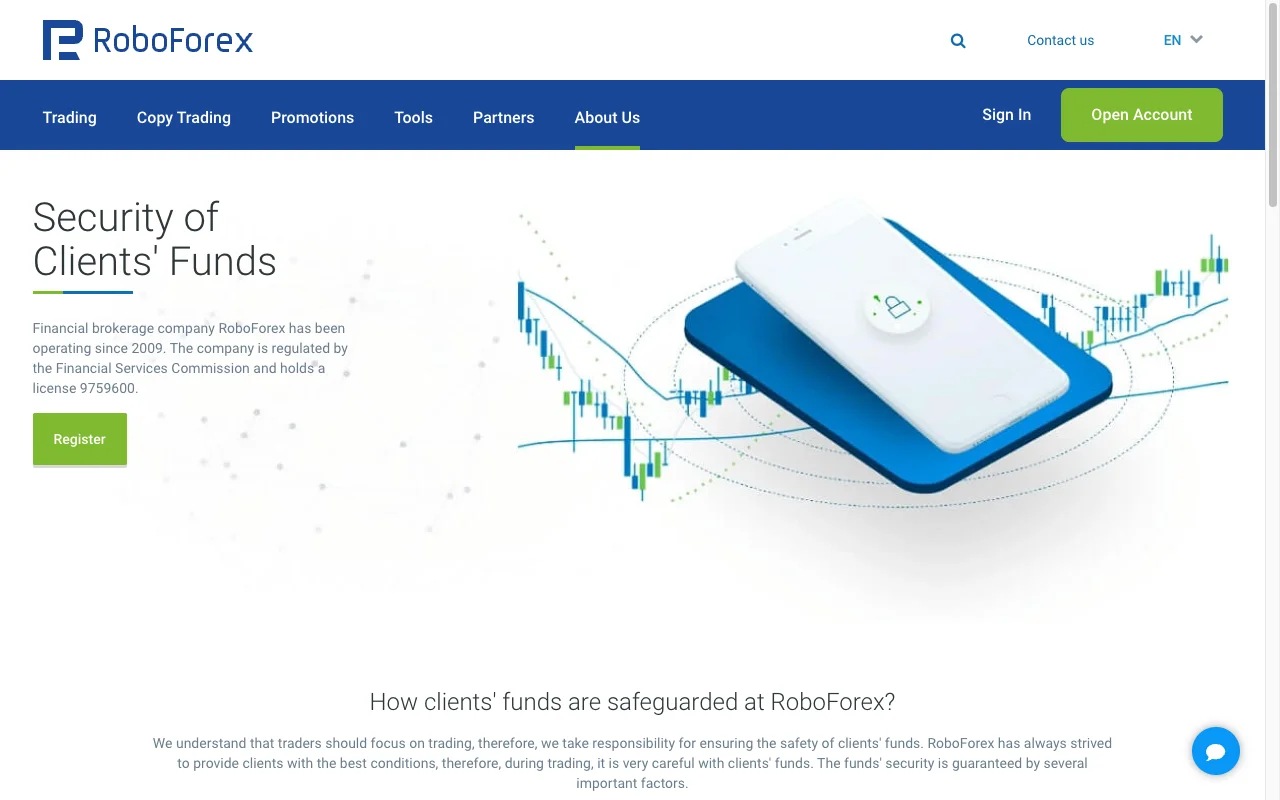
On the RoboForex side the arrangement is simpler and offshore: RoboForex Ltd, FSC Belize licence 9759600, holds client funds in segregated bank accounts, provides negative balance protection (the balance is topped back up to zero at the company's expense if volatility pushes it negative), carries a civil liability insurance programme with a limit of 2,500,000 EUR, and holds a Verify My Trade execution-quality certificate.
Three compensation schemes that all say "20,000 EUR" and mean different things
| The Financial Commission (RoboForex Ltd) | EdW (RoboMarkets Deutschland) | ICF (RoboMarkets Ltd, Cyprus) | |
|---|---|---|---|
| What it is | A private dispute-resolution body funded by member brokers. RoboForex holds "A" category membership | Statutory German scheme under the Investor Compensation Act (AnlEntG) | Statutory Cypriot scheme under CySEC |
| Ceiling | 20,000 EUR per case | 90% of value, max 20,000 EUR per creditor | 20,000 EUR per client, regardless of how many accounts |
| Trigger | The member refuses to comply with a ruling of the Commission | The firm cannot meet liabilities arising from securities transactions | The firm cannot meet its obligations to clients |
| Who is covered | Clients of member brokers who go through arbitration first | Creditors of the German firm | Retail clients only — professional clients are excluded |
| Exclusion worth knowing | It is not a deposit guarantee and not a state scheme | No claim at all if funds are not held in euro or another EU member state currency | Cover ends the moment you re-categorise as professional |
The distinction that matters most: the Financial Commission is not a regulator. It is an industry arbitration organisation, and its fund exists to cover the case where one of its own members ignores an award. It is a real and useful mechanism — but it is not equivalent to a statutory investor compensation scheme, and treating "20,000 EUR protection" as one number across the two brands is the single most common misunderstanding about this group.
The same applies to the 2,500,000 EUR insurance figure at RoboForex. Civil liability insurance covers the company against claims arising from fraud, errors, omissions and negligence. It is not a per-client entitlement and it is not triggered by the company failing.
The currency clause that can void your German protection
This one deserves its own section because it is stated once, in the imprint, and almost never repeated anywhere else:
"According to the AnlEntG, liabilities from securities transactions are protected up to 90% of their value, but not more than €20,000 per creditor. The claim for compensation does not exist if funds are not denominated in the currency of an EU member state or in euros."
RoboMarkets EU offers accounts in EUR, USD, CHF, CZK and SEK. Two of those five — USD and CHF — are not EU member state currencies. And a USD account is precisely what many people open, because the natural use case for this broker is buying US stocks on NYSE and NASDAQ and a USD account avoids conversion on every trade.
So there is a genuine trade-off with no free answer:
| EUR account | USD account | |
|---|---|---|
| EdW compensation claim | Yes — 90% up to 20,000 EUR | No claim under the clause above |
| Buying US stocks | Conversion on every buy and every sell | No conversion cost |
| Buying Xetra and EU stocks | No conversion | Conversion on every trade |
| Currency exposure on idle cash | None against your home currency (in the eurozone) | Full EUR/USD exposure while uninvested |
The company's own risk warning makes the second half of this explicit: "Trading securities in a currency other than the euro exposes you to exchange rate risk." A reasonable middle path for a eurozone investor is to hold the cash balance in EUR — where the compensation claim exists and idle money is not exposed — and accept conversion on US trades, unless you are trading US stocks often enough that conversion costs clearly outweigh a protection ceiling you will only ever use in an insolvency.
Taxes: nobody files anything for you
This is the part that surprises people who are used to a domestic broker doing the paperwork.
Because the accounts behind the Prime and Prime Stocks models are operated by RoboMarkets Ltd in Cyprus, the arrangement does not make the broker a domestic paying agent in your country. In Germany, for instance, that means Abgeltungsteuer is not withheld at source — you calculate, declare and pay it yourself. The same logic applies across the EU: there is no domestic tax statement of the kind your local broker or bank issues, so gains land in your annual return as foreign capital income that you compute from your own records.
Three consequences follow:
- Your loss offsets are your own responsibility. A domestic broker often nets losses against gains automatically within the year. Here, if you do not track it, nobody does.
- Exchange rates enter the calculation. Most tax authorities require foreign-currency proceeds converted at a prescribed rate on the transaction date, not at today's rate. Keep the trade dates, not just the amounts.
- Reporting still happens — just not to you. EU-based financial institutions exchange account information between tax authorities. "No tax statement" does not mean "invisible".
The Swedish ISK is the deliberate exception. It is flat-taxed on account value rather than on realised gains, RoboMarkets reports the capital base to Skatteverket annually, and the figure is pre-printed in the tax statement — the 2026 rate is 1.065% of account value. You do not itemise trades. That is a genuinely different product, and it exists only for Swedish residents.
None of this is tax advice — rules differ by country and change — but the structural fact is the same everywhere: plan on self-declaration and keep records from day one.
Check the conditions at the source
Account currencies, the compensation scheme and the fee schedule all sit in the same place. Read the imprint and the deposit page before you fund anything — that is where the clauses in this article come from.
Open the RoboMarkets EU conditionsInvesting in securities carries the risk of substantial capital loss.
Dividends from US stocks: the second tax layer
If you buy US shares — which is the main reason most people open this account — dividends are taxed in the United States before they reach you. The default withholding rate for non-US individuals is 30%. Where a double taxation treaty exists between the US and your country of residence, filing a Form W-8BEN with your broker reduces it, commonly to 15%. The form certifies foreign status and claims the treaty rate; it reduces the withholding, it never eliminates it.
The reduced rate is worth real money on a dividend portfolio: on 2,000 EUR of annual US dividends, the difference between 30% and 15% is 300 EUR a year, every year. RoboMarkets does not publish a description of its W-8BEN procedure on the public site, so treat this as a task rather than an assumption — check the tax documents section of your Members Area after opening the account, and ask support directly if you cannot find it. In most countries the withheld US tax can also be credited against domestic tax on the same income, which is another reason to keep the dividend statements.
What to keep, and for how long
Because there is no year-end statement doing the work for you, the records are the product. From day one, archive monthly:
- Trade history export with dates, instruments, quantities, prices and currency — the platform holds it, but export it anyway; account access is not guaranteed forever.
- Account statements showing opening and closing balances per month.
- Deposit and withdrawal confirmations, including the fees charged — withdrawal fees are frequently deductible costs.
- Dividend statements with the amount withheld at source.
- Currency conversion records, if your account currency differs from the currency of the instruments.
Keep them for at least the retention period your tax authority requires — commonly five to seven years — and keep them somewhere that does not depend on logging into the broker.
When this group is the wrong choice
An honest article has to include this section:
- You want a broker that handles your tax paperwork. Then a domestic broker or bank is worth its higher commissions. The admin saved is real, and for a buy-and-hold investor it can exceed the fee difference.
- You want statutory protection on a large USD cash balance. The EdW currency clause means the German scheme will not help you there. Either hold EUR or keep large balances elsewhere.
- You live in France, Belgium or the UK. RoboMarkets Deutschland's permitted list of 27 countries does not include them, and RoboForex excludes the EU/EEA and the UK explicitly.
- You are an EU resident who wants leveraged FX. The group stopped offering it to EU retail clients on 30 December 2024, and routing around that through an offshore entity means giving up MiFID II, ICF, EdW and the ESMA protections at once.
- You would need professional client status only to get leverage. The cost of that status is the compensation cover itself.
Where it does fit: an EU resident who wants low-friction access to Xetra, NYSE and NASDAQ from 100 EUR, is comfortable filing their own return, and will hold the balance in a currency that keeps the compensation claim alive.
Frequently asked questions
Is my money safe at RoboMarkets?
Client funds are held in segregated bank accounts of RoboMarkets Ltd in Limassol under strict earmarking, and the German entity is affiliated to the EdW compensation scheme covering 90% of value up to 20,000 EUR per creditor. Segregation protects against the firm's own creditors; the compensation scheme covers the insolvency case, subject to the currency condition above.
Does RoboMarkets withhold tax for me?
For most clients, no. The accounts behind Prime and Prime Stocks are operated from Cyprus, so the broker is not a domestic paying agent and does not deduct tax at source. The Swedish ISK is the exception — it is flat-taxed and the capital base is reported to Skatteverket.
What tax rate applies to my profits?
Whatever your country of residence charges on capital income — the broker's location does not change your own tax residence. Check the current rate and reporting form locally, and treat the gains as foreign capital income.
Does the 20,000 EUR cover apply to me if I trade as a professional client?
No. Re-categorising from retail to professional removes Investor Compensation Fund cover, along with the ESMA retail protections such as leverage caps and standardised margin close-out.
Do I pay tax on unrealised gains?
In most countries, no — tax applies on realised gains and on dividends. The Swedish ISK is different by design: it taxes account value at a flat rate regardless of whether you sold anything.
About the Author
Related Posts
RoboForex vs RoboMarkets: which company actually opens your account — and what changes because of it
Four companies, four licences, four country lists. Your residence decides which one opens your account, whether you can trade CFDs at all, and how much of your money is actually protected.
RoboForex and RoboMarkets from A to Z: accounts, real costs and the first 30 days
Which account types exist, what each one really costs, how verification works, which platform is worth your time, and the order in which to do things.
3 mistakes that cost the most on RoboForex and RoboMarkets — and how to avoid each one
None of these are trading mistakes — they are administrative ones, which is why they are so common. Each has a number attached and takes ten minutes to avoid.
RoboForex – A quick overview of a broker. Is investing here reliable and safe?
RoboForex is an international broker that has been around for more than a decade. The broker is based in Cyprus and was founded in 2009. It is regulated in Belize by the IFSC (International Financial Services Commission) to provide trading facilities in securities and commodity-based derivatives. Almost 12 years into the business, RoboForex now has…
Wise.com – can you really save money on transfers? My story – your thoughts and opinions.
Hi! Today I would like to delve into a subject that will certainly be of interest to people like me, who work in Great Britain and regularly share their earnings with the family in their beloved homeland. Of course, everybody will find it helpful, no matter where he or she works and what currency they…
Comments
No comments yet. Be the first to share your thoughts!
Leave a Comment